Once in Helsinki Finland it was early December and nearing Christmas time. The short daylight hours were bitingly chilly. I made a habit of spending time in warm cafes savoring coffee and pastries folded with cinnamon, cardamom, or saffron.
In walking around the festive city squares I also was able to pick up hot glogi at cafes or market stalls. This became the city’s distinctive taste; hot mulled wine (alcoholic or non-alcoholic), with bitter slivered almonds, raisins, spices and orange peels settled zestily at the bottom of the cup.


I had made appointments to observe two international schools; one funded by the city and one independently funded. Additionally, I spent my last day in Finland at a public elementary school.
My first experience in a Finnish school was at Ressu Comprehensive School. Ressu is an elementary school funded by the city with a ratio of 41 students: 2 teachers. The curriculum combines the National Finnish curriculum with International Baccalaureate curriculum. Both curricula were described to me as inquiry-based.
In 2015, Finnish curriculum became more oriented towards academic and emotional “skills” rather than content. In 2016, those changes were implemented in schools.
At Ressu Comprehensive School classes are taught in both Finnish and English. I attended Arlene’s first grade class taught in English.
As I walked down the hallway to Arlene’s class I noticed child-sized outlines of bodies labeled by bodily system. The wall label read “Children worked in groups and researched different parts of the human body.”


As soon as I came in Arlene began to read her students’ letters. The children had exchanged letters with their pen pals living in New York City. Many students eagerly volunteered to share their letters. In her interactions with students Arlene addressed and responded in ways that suggested that she was genuinely interested in their inner lives. She asked about students’ emotional responses to what went on in the classroom. “Alexander, how did you feel as I was reading your letter aloud?” “How did you guys like writing letters to your friends?” She also framed comments and requests in positive terms. “Hey and excellent job remembering capitals at the start of a sentence.” “I love learning more about you!!” “I love quiet hands.”

Arlene’s management was never negative. As the children became increasingly excited she told them to “please respect each other.” When they called out she said, “I don’t hear people who call out.” At one point she asked an off- task student: “Eli, is everything ok?”
As relevant questions came up she used technology to assist. One child had written in her letter that there were more people in New York City than in all of Finland. Arlene googled the population of NYC. Laughing, she told her students, “Just be grateful you have so much room!”
After she’d read quite a few letters aloud Arlene declared: “Let’s write a letter to the class.” She prepared to write on the board and asked the class for suggestions.
Dear class,
We like the idea that you wrote us.
A student said: “Wait- wasn’t it our idea?”
Arlene asked him to corroborate before responding, “Um, I’m not that into ownership. It’s collaborative.”
The child volunteered: “It made us happy that you wrote to us.”
After Arlene elicited content and recorded a rough letter on the board she asked the children for the rules of punctuation. “Put capital letters at the start of sentences!” “Put spaces before sentences!”
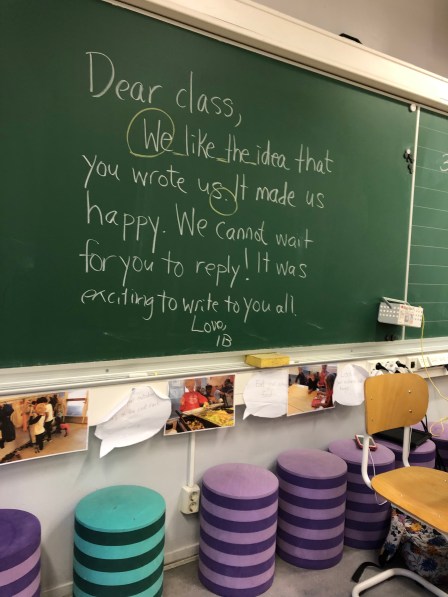
After the letter was complete and signed “Love, IB” the class edited an ongoing collaborative creative project with the sixth graders. The first grade class drew pictures pertaining to a story and exchanged them with the sixth graders. The sixth graders used the drawing they were given to extrapolate a story, which they paired with the picture. Finally, the pictures and accompanying stories were pieced together. To end the class period Arlene called on her students to read the story- one student per line. The class worked together to edit the writing.

 The living learning experience