Shibumi part 1

Shibumi is a Japanese word that means ‘effortless perfection’. Anything that is Shibumi is quiet in refinement, noble and fulfilling in a manner that is not shaped exclusively by analytical thought. In Japanese culture, Shibumi implies ‘a simplicity of spirit; an attitude of refinement without pretension, honesty without apology, beauty without artifice. Western mystics try to attain or achieve a state of inner peace, but Shibumi must be found, not won.’ Shibumi is understanding rather than knowledge, it is harmony in action. In art, it is understated beauty, articulate brevity. In philosophy, it is spiritual tranquility that is not passive; it is being without the angst of becoming.

*From Shibumi’s Website

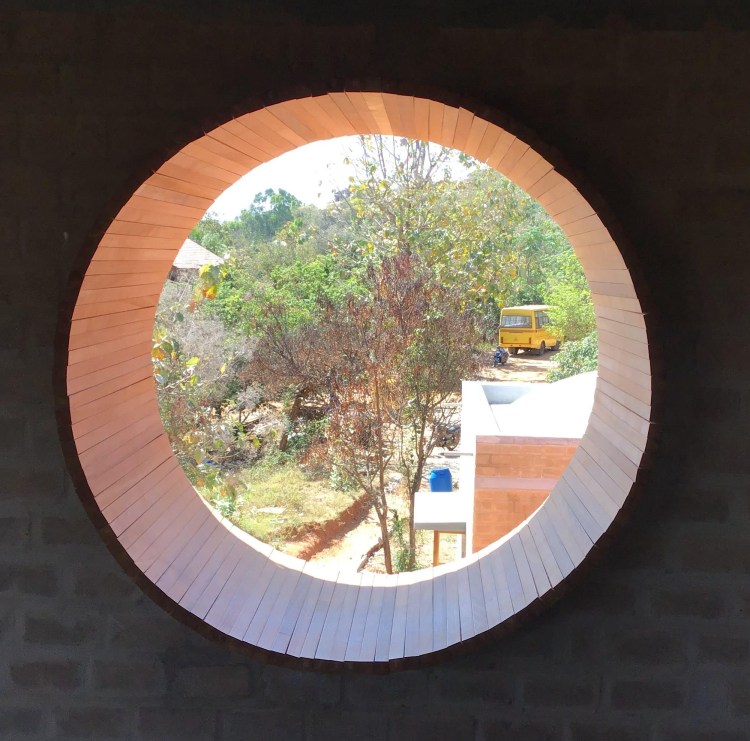
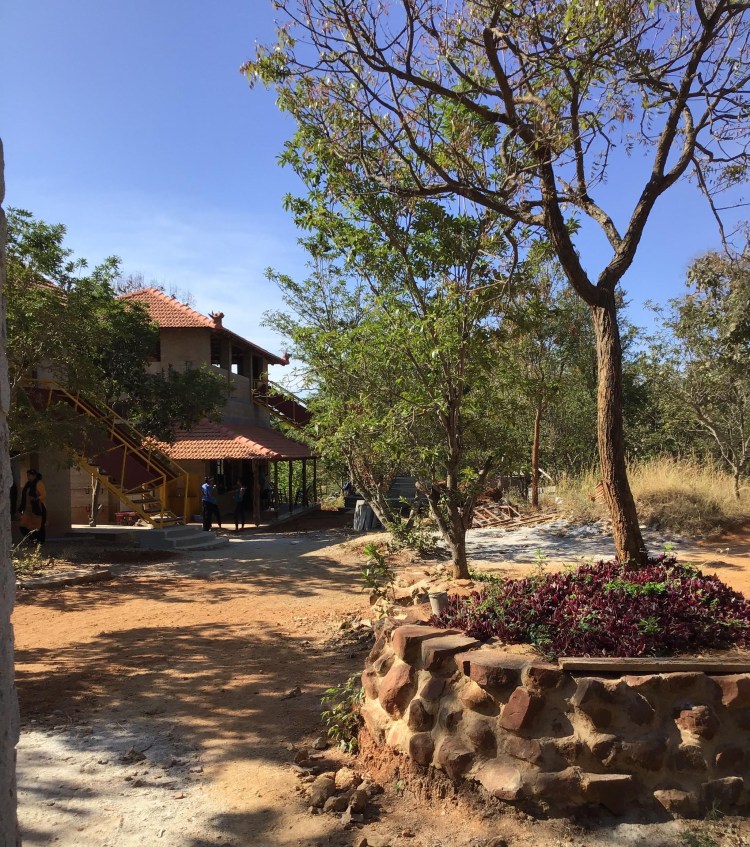
Shibumi is a school influenced by J. Krishnamurti’s writings and talks on education.  It is located about an hour away from the city of Bangalore in Southern India.  Krishnamurti has founded schools in India, the UK, and the US.  He has written and dialogued extensively on the topic of education as it relates to human civilization and personal evolution.  His coming-of-age story is mythic- as a child he was taken from India to England by the Theosophical Society  and groomed to be the next spiritual world leader.  At the peak of his powers he disavowed his revered role, asserting that every person must inquire into the essential questions without giving any one else the authority to provide answers.

Krishnamurti became known for probing into the nature of reality and our relationship to it.  In numerous talks and dialogues he invites us to look at the movement of our thoughts, cultivating a freedom from our ingrained assumptions, cultural conditioning, automatic thought patterns, etc.

In his dialogues with adults and children Krishnamurti insists on rigorous honesty in looking to allow for total freedom of being.  Attentiveness to internal perceptions and acting out of this awareness changes our relationships to others and to the world around us.  Education should support this transformation.

In the talk below Krishnamurti calls the meaning of education “a holistic approach to life..”

I spent my time at Shibumi fully immersed in the life of the school.  The school community had just shifted campuses after more than ten years.  The new campus was newly built and my first day at Shibumi was the first day for all in the new space.  Now that I am back in Southern California in the midst of a global paradigm-shift  my heart yearns for the sweetness of this place and the incredible love and generosity that I experienced there.
unnamed-5

I felt this love when I took the packed bus in the morning, surrounded by excitable kids and laughing teachers.  I felt it when I sat on the floor of the kitchen in a circle with students, parents, and helpers chopping and peeling vegetables for the lunch that day.  The whole school mobilized to clean the school, each with a job to do.  The older kids helped the younger ones.  Treating one another with patience and compassion was effortless.

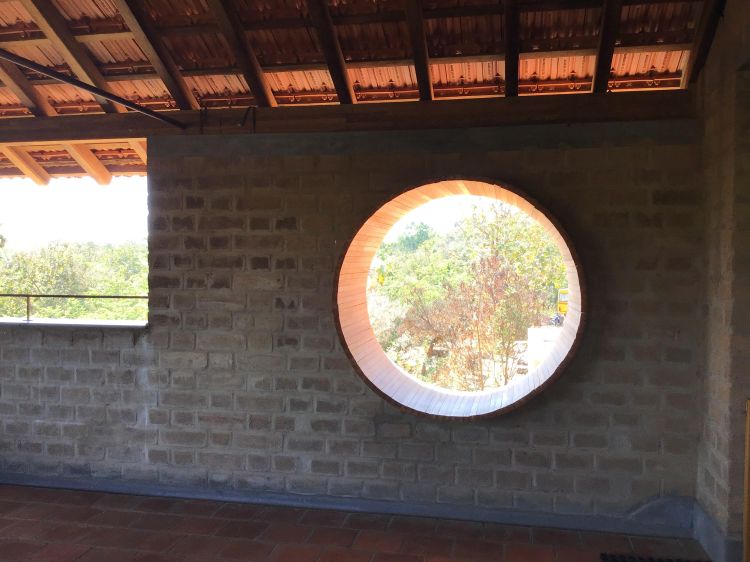
Every day the school started and ended with fifteen minutes of quiet time.  The community gathered together wordlessly to sit along the perimeter of the room with the large windows overlooking the land.  Shibumi is surrounded by farmland and scattered villages.  The light streamed in, golden, as I listened to the gentle movements of birds and leaves.
unnamed-2

unnamed

Shibumi’s website: https://www.shibumi.org.in/

Herttoniemenranta Primary School

I spent my last day in Finland at a public elementary school in the outskirts of Helsinki.

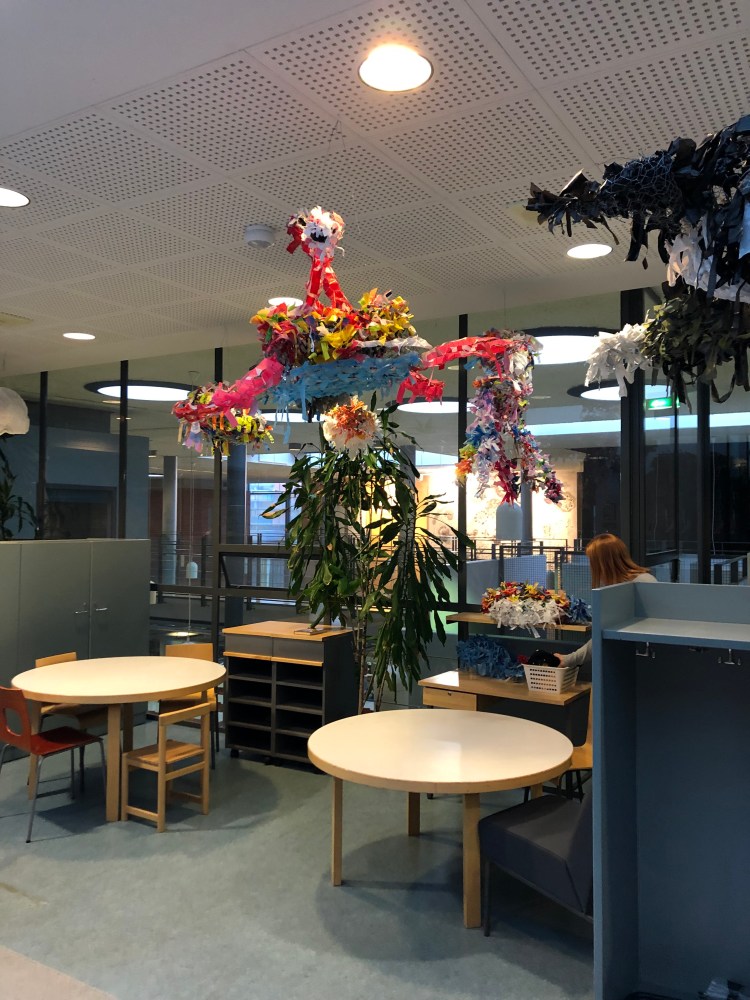
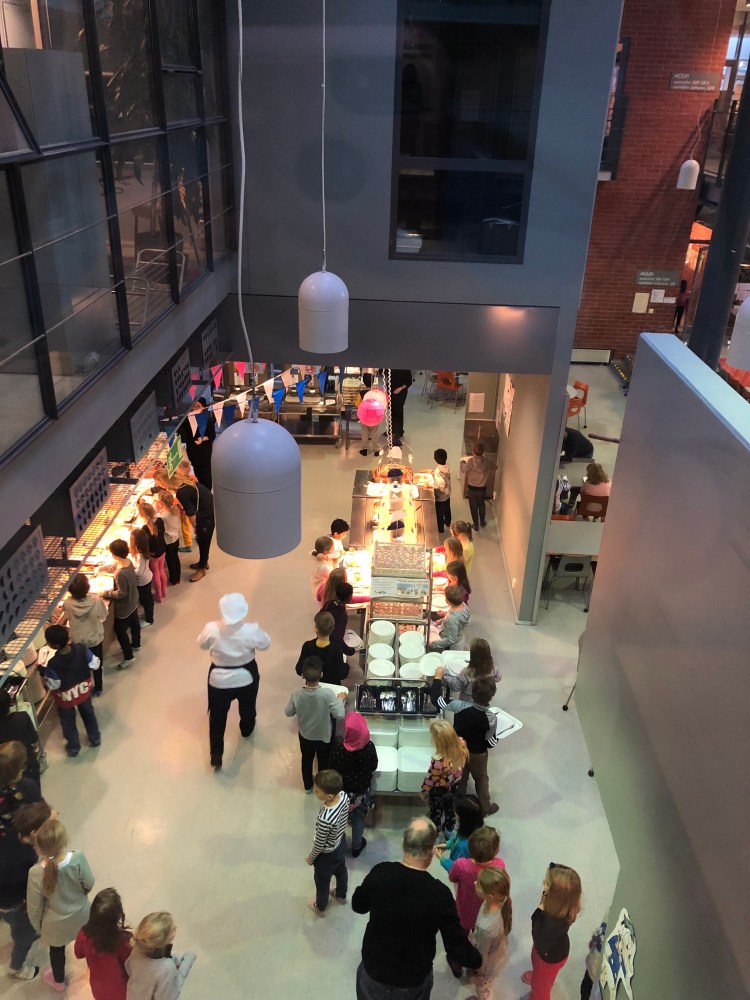
My first impression of the school building was openness and spaciousness yet somehow also coziness; the first story functioned as a wholly communal space festively decorated with a Christmas tree amongst reading, socializing, and dining areas, as well as a large stage.  Learning areas on the upper level encircled and looked down upon this open space.

IMG_4539

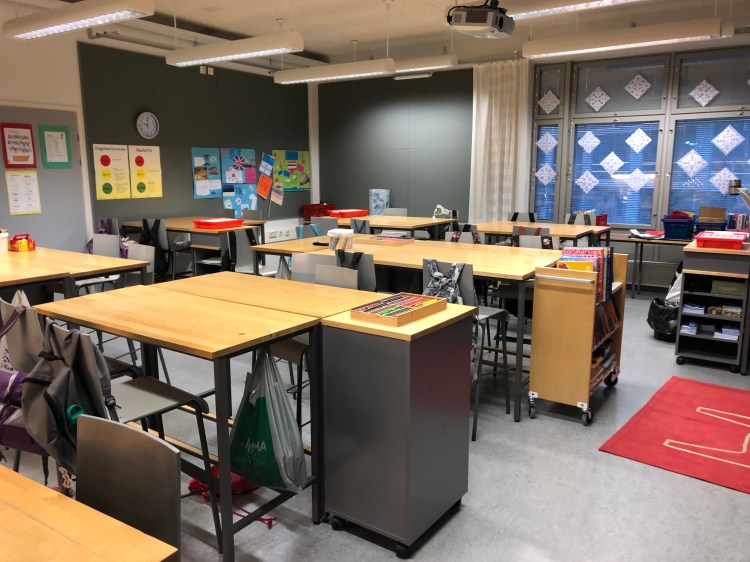
Classes were, of course, conducted in Finnish, though teachers made a point to discreetly (and indiscreetly) translate.  I spent the day shadowing a third grade class.  The children had just started learning English a few months prior in the fall.  The first class that I participated in combined a general education class (21 students) with a special education class (10 students). Some children in the special education class needed more support academically while others had behavioral and/or social differences.  These two classes operated in adjacent, adjoining classrooms; the learning happened separately as well as together depending on the activity.

IMG_4493IMG_4509IMG_4510

That day a special teacher came in to teach the combined class a lesson on mental coping skills.  Students were seated at five high tables.  Students were given a red paper and a green paper.  For the given scenario students were to list self-defeating thoughts on the red paper and encouraging thoughts on the green paper.  The teacher began by eliciting encouraging thoughts from the students in response to the prompt “If you have to sing in front of the class.” Students raised their hands and engaged readily. The teacher translated the responses, from, “Everything will be alright I can do this.” to “I don’t give up.” to “I’m having fun.” to “I’m enough.”

Students partnered and wrote down self-defeating and self-encouraging thoughts for a scenario.  Then the teacher invited groups up to the front of the class to face each other and go back and forth voicing alternating self-defeating to self-encouraging thoughts.  After each duo finished this process the students and teachers clapped.  The home room teacher whispered to me that students liked to be at school.

After the lesson the third graders regrouped to discuss their outing to take a swimming class that day.  The curriculum states that every Finnish citizen must swim-  students take four swimming lessons a year through the Finnish Swimming Teaching and Lifesaving Federation.

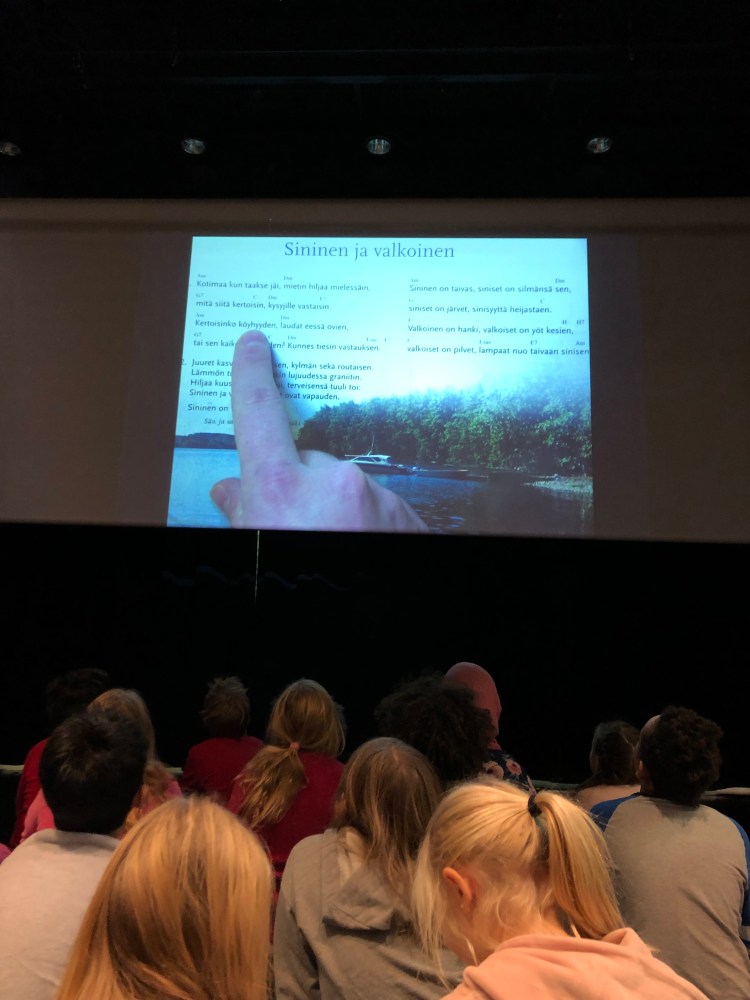
The day that I visited turned out to be a celebratory one; it was Itsenäisyyspäivä, Finnish independence day.  I joined some first graders on the stage in the great common area as they practiced singing patriotic Finnish songs.  The lunch was a special grilled salmon- delicious and free for all students.

IMG_4521IMG_4511

There was a definite emphasis on multiculturalism.  The English teacher Yanna told me that there were 39 languages spoken at Herttoniemenranta School.  She estimated that 40 percent of students were not from Finland.  I saw evidence that this multiculturalism was celebrated- many drawings with various international flags, “welcome” written in different languages, a large map with students’ home countries proudly marked and their names linked to countries around the world.

Information about Herttoniemenranta Primary School in English:

https://www.hel.fi/peruskoulut/fi/koulut/herttoniemenrannan-ala-aste/in-english/education/

International School of Helsinki

Helsinki grew colder and darker as the winter days deepened.

I woke up in the early morning and layered on all of the clothing I could.  Once on the city street the morning rhythms seemed out of sync with the feeling of perpetual night.

International School of Helsinki spans transitionary-kindergarten through 12th grade.  It is an independent International-Baccalaureate World School.  There is a lower school (TK-5) and an upper school (6-12).

IMG_4295

Once inside the main lobby ISH has a feeling of order and monumentality.  A dense collection of colorful international flags frames the corridor.  A “living wall” of tropical ferns and mossy vegetation is set cleanly into a spare white entryway.  Each stair in the impressive central staircase features a color-coded multiplicative equation.

Once inside the spacious auditorium I found the fifth grade class in dialogue with the principal of ISH in a sectioned-off area upstairs.  The principal was leading a presentation and discussion on sustainability.  She asked students, “What do we need to do as individuals to be committed to sustainability?”  before eliciting their recommendations to make the school more sustainable.  “What are some questions we need to ask ourselves as a school?”   Students volunteered thoughts catalogued by the principal: “Should we use solar power?”  “Do we need a green roof?” “LED lights take practically no energy…” To which a student responded, “Have you heard of the super cool new bio lights?  They mimic countries with more sunlight..”

After around fifteen minutes it was time for my appointment to observe a transitional kindergarten class.  I tiptoed out and found a large classroom behind the living wall.  There were eight three year olds in the class.  They would turn four that year.  There were three adults present.

The group had gone to Cable Factory that morning- a cultural center housing a theater museum.  By the time I arrived the class spent the majority of the time in play before afternoon snack and a closing circle.

The environment was a relaxing one.  Emotions flared as tired children interacted.  When these occasions occurred the teachers focused their full attention on facilitating resolutions.  One of the teachers told me,  “The only thing they need is trust.”  She assured me that even children so young could develop self-awareness and therefore self-regulation.

A little boy started to cry and one of the other teachers, Cath, intervened.  She instructed him to take a deep breath.  “Ivan, Can you explain?”  She said, “I’m happy you’re upset because it means that you know you’ve done something wrong.”    Cath attempted to elicit Ivan’s’ apology (I wasn’t clear on what had happened) , but Ivan could not seem to say it.  Cath was persistent.  “You need to say sorry before you can play again, Ivan.”  Ivan: “Sorry, Sebastian.”  After saying the words Ivan crumpled to the floor and cried.

Screen Shot 2019-08-16 at 5.36.32 PM.png

Snack included banana, watermelon slices, and buttered crackers.
Teacher facilitated learning continued.

“Take three grapes.”

“How many grapes do you have?”  “This one’s for “fffff…. Who could that be?”

After the class helped to tidy up everyone sat in a circle.  The question each person would answer was: what was your favorite part of the museum?

After everyone had spoken, a student was chosen to be “the teacher” to choose a number for the class to count up to.  To close the school day the class sang a goodbye song.

After dismissal teachers helped students layer, zip, tuck, and secure themselves into warm clothes and boots. 

Information on The Cable Factory: https://www.kaapelitehdas.fi/en/info

Ressu Comprehensive School

Once in Helsinki Finland it was early December and nearing Christmas time.  The short daylight hours were bitingly chilly.  I made a habit of spending time in warm cafes savoring coffee and pastries folded with cinnamon, cardamom, or saffron.

I had made appointments to observe two international schools, one funded by the city and one independently funded.  I spent my last day in Finland at a public elementary school.

My first experience in a Finnish school was at Ressu Comprehensive School.  Ressu is an elementary school funded by the city with a ratio of 41 students: 2 teachers.  The curriculum combines the National Finnish curriculum with International Baccalaureate curriculum.  Both curricula were described to me as inquiry-based.  

 In 2015, Finnish curriculum changed-  academic and emotional skills became prioritized over content.  In 2016, those changes were implemented in schools.    

At Ressu Comprehensive School classes are taught in both Finnish and English, respectively. I attended Arlene’s first grade class taught in English.  

As I walked down the hallway to Arlene’s class I noticed child-sized outlines  of bodies labeled by bodily system.  The wall label read:

Children worked in groups and researched different parts of the human body.

At the start of class Arlene began to read her students’ letters out loud.  The children had exchanged letters with their pen pals living in New York City.   Many students eagerly volunteered to share their letters with the class.  In her interactions with students Arlene addressed and responded in ways that suggested that she was genuinely interested in their inner lives.  She asked about students’ emotional responses to what went on in the classroom.  For instance: “Alexander, how did you feel as I was reading your letter aloud?” and “How did you guys like writing letters to your friends?”  She also framed comments and requests in positive terms.  She said: “Hey and excellent job remembering capitals at the start of a sentence.” “I love learning more about you!!”, and “I love quiet hands.”  

As the children became increasingly excited Arlene told them to “please respect each other.”  When they called out she said, “I don’t hear people who call out.”  At one point she asked an off- task student: “Eli, is everything ok?”  

IMG_4371

As relevant questions came up she used technology to assist.  One child had written in her letter that there were more people in New York City than in all of Finland.  Arlene googled the population of NYC.  Laughing, she told her students, “Just be grateful you have so much room!”     

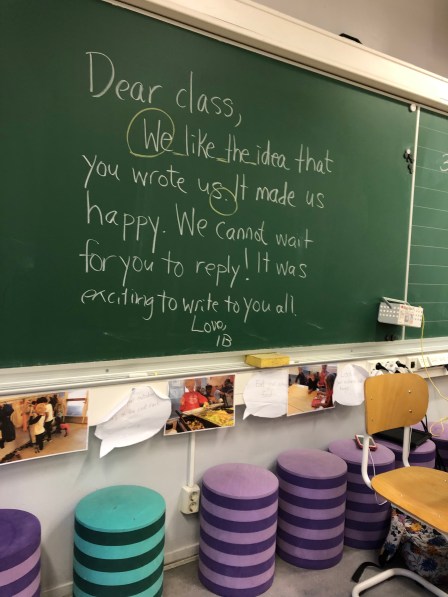
After she’d read quite a few letters aloud Arlene declared: “Let’s write a letter to the class.”  She prepared to write on the board and asked the class for suggestions.  The letter began:

Dear class,

We like the idea that you wrote us.  

A student said: “Wait- wasn’t it our idea?”

Arlene asked him to corroborate before responding,  “Um, I’m not that into ownership.  It’s collaborative.”

The child volunteered: “It made us happy that you wrote to us.”

After Arlene elicited content and recorded a rough letter on the board, she asked the children for the rules of punctuation.  Students asserted “Put capital letters at the start of sentences!” and “Put spaces before sentences!”  

IMG_4368

After the letter was complete and signed “Love, IB” the class edited an ongoing collaborative creative project with the sixth graders.  Arlene’s first grade class had created a story and drawn illustrations pertaining to the story they created.  They exchanged just the drawings with a class of sixth graders.  The sixth graders used the wordless drawing they were given to extrapolate their own story, which they used to caption the illustrations. Finally, the pictures and accompanying stories were pieced together.   To end the class period Arlene called on her students to read this final product- one student read each line.  The class worked together to edit the writing.  

IMG_4370.jpg

Education and Incarceration in Finland

I was able to visit and observe in three schools in and outside of Helsinki while I was there last winter.

Initially I wanted to visit Finnish schools because I was curious about the Finnish educational system.  I had heard people talk about how progressive and successful Finnish schools are.

Before I chronicle my personal experiences in subsequent posts I wanted to explore international perceptions of Finnish society in regards to two systems: education and incarceration.  To quote Gandhi, ‘The true measure of any society can be found in how it treats its most vulnerable members’.

A Washington Post article attempts to frame the hype around Finnish education:

“If you have paid any attention to the education debate in this country during the past dozen years or so, you’ve heard that students in Finland score at or near the top of international test scores, time and time again. You may know that, among other things, Finland has no standardized tests, starts formal reading instruction at age 7, requires all general teachers to have a master’s degree and makes sure no student goes hungry.”

This video from BBC explores the role of “trust” within the Finnish system- the mutual trust between students and teachers as a factor in pedagogical success.

This national attitude of support & respect towards citizens extends beyond the educational system.  Finland is also known for it’s “gentle justice” prison system.  Justice is “gentle” because convicted prisoners have rights. There is also a practical and compassionate approach toward gradual reintegration into society.

From a 2012 research publication: “As far as methods of punishment go, the Finns believe in fines, short sentences, open prisons, and heavy emphasis on gentle social rehabilitation.” As a result, “Finland has one of the lowest per capita crime rates in the world, as well as significantly lower rates of recidivism as well.”

About 1/3 of Finnish prisoners are rehabilitated in open prisons.  In these open prisons there aren’t “gates, locks, or uniforms.”  From Public Radio International, regarding Kerava Open Prison in Kerava, Finland:

There aren’t any gates, locks or uniforms — this is an open prison. Everyone at the Kerava open prison applied to be here. They earn about $8 an hour, have cell phones, do their grocery shopping in town and get three days of vacation every couple of months. They pay rent to the prison; they choose to study for a university degree in town instead of working, they get a subsidy for it; they sometimes take supervised camping and fishing trips. 

If you’d like more information on these policies and perceptions:

Washington Post article:

https://www.washingtonpost.com/education/2018/11/26/educator-finland-i-realized-how-mean-spirited-us-education-system-really-is/?noredirect=on&utm_term=.61fa9e34c635

On Gentle Justice approach in Finland:

https://epublications.marquette.edu/cgi/viewcontent.cgi?article=1057&context=socs_fac

Information on Kerava Open Prison:

https://www.pri.org/stories/2015-04-15/finlands-open-prisons-inmates-have-keys

Europaskolan part II

For part I:

https://thelivinglearningexperience.com/2019/04/19/europaskolan-part-i-mathematics/

After mathematics class I made my way back to Robert’s classroom.  I immediately noticed pristine-looking art supplies and mirrored walls.

IMG_4100

Robert warned me that he needed to have a talk with his students about competitiveness and social exclusion.  Once students filed in and took their seats Robert let the students know what they would be accomplishing in class before launching into the discussion.   Robert took a good amount of time to deconstruct a conflict that occurred outside of class that was negatively affecting the social health within the class.  He involved all students, asking his class what happened and allowing students who wanted to speak speak.  He started by putting the conflict into context and continued to do that as he solicited students’ perspectives and opinions.  Robert communicated clearly.  At one point he said,  “As soon as you have to make excuses something’s wrong.  You shouldn’t have to make excuses.”

I was impressed by the depth of the discussion.  It seemed to be a sensitive topic and certain students became emotional.  Robert acted patiently and did not back off until the class had come to a place of catharsis.

Afterwards students launched into a project.  Robert: “We have six types of energy that we discovered yesterday.  So we need six groups to work on these different subjects.  It’s not about who we work with.  It’s about what we work with.”

Robert showed me Dan Rothstein’s book, “Make Just One Change: Teach Students to Ask Their Own Questions.”  This book inspired the activity that followed.

IMG_4102.jpg

Students would work in groups to come up with an experiment to show how each type of energy works.  (Sound, Chemical, Radiant, Electric, Atomic and Mechanical.)

The scope of the project was to:

  1. Ask any and all questions about the assigned type of energy
  2. Delegate
  3. Research and prepare for experiment

The aim of that class period was to ask tons of questions.  Robert told students, “Write down as many questions as you can.  No judgement.  Any question.  In exactly the way it’s been asked.  Then, Look at the questions and write an “O” next to an open question, and  “C” next to a closed question.  Look at the closed questions and see if you can make them open.  Look at the open questions and prioritize them.  Once you’ve prioritized, make groups of questions that belong together in some way.”  Robert then gave the class some examples of grouping.

Robert: “It’s not a race.  I want this done well and not quick.”

A student asked, “Is this part Swedish or English?”

Robert replied, “You choose!”

Before the school day ended, the class needed to practice for a Christmas recital that would be taking place in a nearby church.  I was graced with Pocahontas’ “The Colors of the Wind” sung in Swedish and an English version of Michael Jackson’s “Black or White”.

Once students were dismissed a child came up to me, gave me hug, and said “That was fun!”


Europaskolan part I

Europaskolan is located on a narrow street in the medieval part of Stockholm called Gamla Stan.  This is the preserved part of the city that attracts tourists from around the world.  Churches loom impressively and forebodingly above eccentric, claustrophobic city streets.  Hoards of people traverse topographic cobbled stone.

IMG_4014.jpg

One would never know that such a beautiful school exists within this microcosm, just beyond a large, nondescript wooden door.   Within the tiered lobby the ceilings are vaulted, the walls are gold-paneled, and classical murals decorate the high walls.

Europaskolan describes itself as an International Baccalaureate World School that also meets all requirements of the Swedish national curriculum.  The school is bilingual; there are classes taught in Swedish and in English.  I observed a class of ten and eleven year olds.  These kids switched between two teachers.  I observed a math class, lunched with the staff, and finally observed a science lesson before the school day ended.

Before the lesson began, students circulated and wrote three compliments about their classmates at those classmates’ desks.  This appeared to be customary in the class.  Students happily socialized in Swedish.

I was so fortunate to get to know their teacher, Robert, who was both passionate about teaching kids to learn through discovery and generous with his passion and knowledge.  Robert utilized many of the same inquiry-based mathematics teaching strategies that I’d been taught while earning my teaching credential at UCSB.  For instance, I immediately saw posters throughout the classroom from what I came to know as a “Math Congress”.  In this type of learning scenario students work together in groups to solve a problem, record their strategy on a poster, and present that strategy to the class.

The math lesson that I observed in Robert’s math class was from the YouCubed curriculum.  I learned about YouCubed from Morgan Senzamici, who was my teacher mentor at Isla Vista Elementary.  It was so interesting for worlds to collide this way- I got to see the same lesson implemented in both Californian and Swedish classrooms.

YouCubed is a free K-12 math resource from Stanford University’s Graduate School of Education.  I would describe the curriculum as constructivist: the lessons are experiential and it is through experience that students are meant to construct meaning and logical systems.

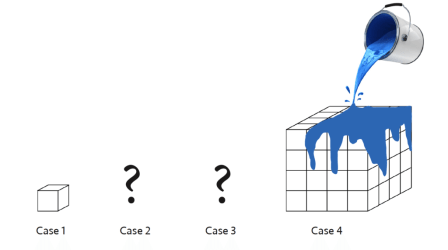
In this particular lesson, students worked with partners, sugar cubes, and markers.  The initial question that Robert posed was: imagine that we paint a 4 x 4 x 4 cube blue on every side. How many of the small cubes have 3 blue faces? The question extended to: how many cubes have 2 faces painted? 1 face painted? And so on.


YouCubed problem
Here is the image that students were given, taken from the YouCubed website.

During the course of the initial conversation, Robert asked open-ended questions. As students explored ideas, he reminded them: “We’re talking about cubes and all of the sudden we’re talking about fractions again and decimals again.”  Once the class had examined the question from different angles, Robert said to his class, “Why don’t you first make a prediction?  Build the cube and see if you were right. That would be interesting.. ”  When a student brought up a perceived complication, Robert’s enthusiastic response was: “Test it! So, test it!”

While the students worked Robert shared with me that making connections between mathematics was something that he consciously made sure to do.  He wanted math to be fun and he wanted to validate student thinking.  At one point a student pointed out that not every amount of sugar cubes can combine to form a cube.  Robert responded, “That’s really interesting.  Write that down in your book.”

IMG_4045 (1)

Robert told me that he was inspired by the British educator Jo Boaler, a mastermind of YouCubed and author of the book “Mindset Mathematics: Visualizing and Investigating Big Ideas.”

He also highly recommended the game “Prime Climb” for the classroom.  Students reiterated- “This is a really good game!”

users_2168342_stores_uploads_16f9748f-04fc-47dd-9366-b99d2d8d7a23img.png_500.png

Prime Climb is made by a company called Math for Love, which, in addition to math games, also offers free math lessons as well as more extensive (not free) curriculum.

Check out Math For Love: https://mathforlove.com/

Check out YouCubed: https://www.youcubed.org/


Berlin Bilingual School

I observed Jennifer’s first & second grade classroom at Berlin Bilingual School. The school is on the outskirts of Mitte close by a large city park.

The classroom was spare and functional, the facilities polished and well-maintained.   Blue autumn light streamed through large windows overlooking lemon yellow leaves and dark brittle branches.  The days were getting darker, earlier. 

img_2903-e1555351531752.jpg

IMG_2907.jpg

At Berlin Bilingual School all subjects are taught in English except German and mathematics. The curriculum is a combination of Berlin State curriculum (Berliner Rahmenlehrplan) and International Primary Curriculum.  Class groups are composed of children spanning two consecutive grade levels (grades 1 +2 and grades 3 + 4).

I initially inferred that the additional adult in the classroom was a classroom aide.  I was incorrect- at Berlin Bilingual School each classroom has a teacher and an Erzieher, or educator.  The role of the Erzieher is to support students socially and emotionally.  The Erzieher remains with children throughout the school day, including at lunch and on the playground at recess.

In addition to academic curriculum there is a rich schedule of electives.  Glancing at the schedule I noticed myriad options: pottery, high speed drawing, yoga, weaving, woodwork, ink on paper, mandala design, dance acrobatics, soccer, karate, decoupage, kickball, library, “bracelets’ n’ braids, “phunky alphabetz”, outdoor games…

After a break Jennifer told the children to come to the carpet.  It was “STEM” (Science, Technology, Engineering, and Mathematics) week.  Jennifer introduced a task to the children- to design a robot.  She gave the kids time to think before inviting them to share ideas with a partner. As students talked she walked through groups, listening to their ideas.  After a thirty second warning, students earnestly shared their ideas with the class.  Later, Jennifer told me that there would be workshops available for them to actually build the robots.

After differentiated classwork Jennifer called students back to the carpet to read a book called “A Grand Old Tree” aloud.

“Boys and girls.  I have a story I’d like to share today.  When we’re listening today we’re going to be listening for words with color, variety, and sparkle.  I want to see if you can notice some words or phrases, some words that together sound great to your ears… If you hear a word you really like, you can go like this (expressive hand movement.)

Jennifer went on to animatedly point out specific words as she read the story. “You can say the leaves fell.  But it’s so much nicer to say the leaves shed.

After she read “A Grand Old Tree”, Jennifer listed the standout words.  “These are some of the words that I liked, that have color, variety, and sparkle.”  She acted out the phrase “crackle and snap” and asked students to guess which phrase from the list she was referring to.

Next, she grouped students into groups of three: one second grader paired with two first graders.

Jennifer: The first thing you need to do is read.  The second grader can help read.  Then you’re going to pick a word or phrase from the list to act out for the class and your classmates will guess which word from the list you chose.”

“We’re going to use communication.”  Jennifer and the Erzieher modeled communication.  They took turns speaking and listening.

I watched as students read to one another before getting up and moving their bodies, smilingly miming trees in various states of contortion.

After the activity, Jennifer asked students, “Does someone want to share how you communicated well?”

Screen Shot 2018-12-17 at 3.07.21 PM

After discussing the merits of listening to your partner, it was time to eat snacks before students filed out of the classroom at the end of the day.  Jennifer invited me to go make some tea in the Kinderkuche (Kid’s kitchen) at the end of the hall.

After discussing education with the warm and kind Jennifer, I stepped back out into the chilly city.


agatha snellen school

Utrecht is the fourth largest city in the Netherlands and like Amsterdam, it is divided by a series of canals.  The canals, winding medieval streets, and trees bursting with yellow, orange, and red leaves made the city very picturesque during my brief fall visit there.

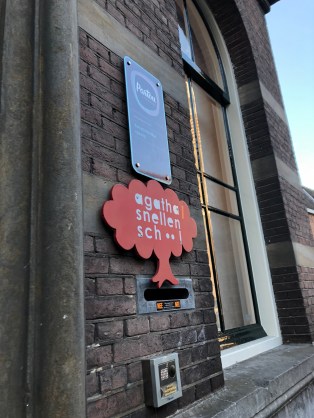
Agatha Snellen school is situated in the city center across from a park bordering a canal.  At the end of the school day children spill out into the park and into the city streets, many riding their bicycles home.

IMG_2314.jpg

I was buzzed into the school by a student.  Children circulated purposefully throughout hallways.  No one was in the front office. I stood around until I caught sight of an adult face.  Anja was very kind- she seemed tickled by my presence there and arranged for me to observe in a kindergarten classroom.

I arrived in Martina’s kindergarten class at the start of the school day.  The room was spacious and colorful.  It looked like a playhouse.  There were multiple child-sized spaces filled with things to touch and play with.  Taped up children’s art shone through large windows bordered with swinging garlands.   Colorful banners hung across the ceiling to celebrate a student’s birthday.

To start the day, the children brought their chairs into a circle and played a trust game.  Martina chose two children to come into the center of the circle.  One wore a blindfold and fell back into the arms of the second.  The children seemed to love this activity and enthusiastically volunteered to be blind-folded.  After a few rounds, Martina called two pairs of kids into the circle at a time.

After the trust game the children chose what they wanted to do.  Each child had his or her own magnet to place under a photograph signifying an activity.  There was a flurry of activity as the children worked together to arrange furniture, bring chairs to various parts of the classroom, and set up learning activities.

IMG_2447 (1)

Martina explained some of the aspects of her classroom while the children organized and settled in.  She showed me a table at the front of the room covered in pictures and objects.  Rain boots, umbrellas, illustrations of trees changing leaves- these items were selected to evoke the current theme of the curriculum.  The table changed when the theme changed.

Art seemed to be an important way to interact with these concepts. A painting station was set up in the back of the classroom.  Martina showed me student art related to the number eight and explained that students practiced this shape with both their dominant and non-dominant hands to develop fine motor skills. The “eight” drawings were decorated with individualistic decorations that seemed to reflect the creative whims of the student.

The students seemed engaged, interacting freely and happily.  A boy and a girl stacked large legos to form a barricade in a corner of the classroom.  A group of girls sat around a table: each had drawn a rainbow on a piece of computer paper.  Children sat next to the playhouse arranging nature-related vocabulary words laminated as strips onto a game board.  They used motorized ladybugs to advance their positions on the board.  Three students tapped iPads near the teacher’s desk as they navigated a math game.

The birthday party began at the end of the class.  The kids brought their chairs back to the table in the center of the classroom.  Martina brought out a “cake”- which was really a piece of plastic made to look like one.  She lit candles and crowned the birthday girl with a paper crown. Everyone sang the Dutch Happy Birthday song loudly.  Afterwards, the English version.  The birthday girl blew her candles out.  A volunteer passed out packets of crackers to each person around the circle from a big basket.  I happily snacked and smiled alongside a group of happy Dutch kindergarteners before finding myself back in the city.

Screen Shot 2018-12-12 at 5.11.56 PM.png


Copenhagen International School

I took the tram to the Copenhagen International School as hoards of urbanites commuted to work.  Countless people on bicycles whizzed past me as I walked to the tram stop in the early morning light.  Copenhagen International School (CIS) is located in Nordhaven, a harbor area on Copenhagen’s coast.  

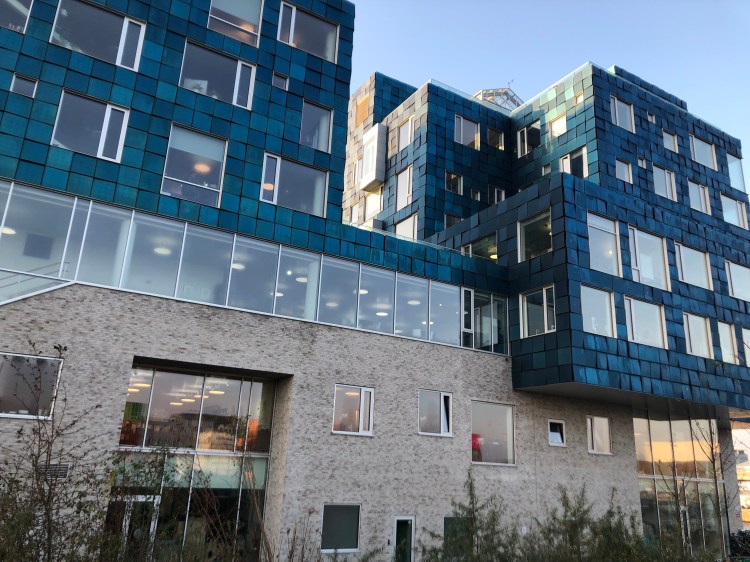
The building of CIS is a big deal from both architecture and sustainability standpoints.  The building can house 1,200 people, making it the largest primary school in Copenhagen.  It is also one of the largest building-integrated solar power plants in Denmark.  Twelve-thousand solar panels make up the building’s exterior. These solar panels produce half the energy that this massive school consumes. 

The walk to CIS from the tram stop was a bit surreal- I left a buzzing urban center to arrive in a part of the city that was quiet, empty, and very, very industrial.  There was a lot of striking architecture- but as I approached a distant CIS, the building towered over the construction zones and distant harbor.

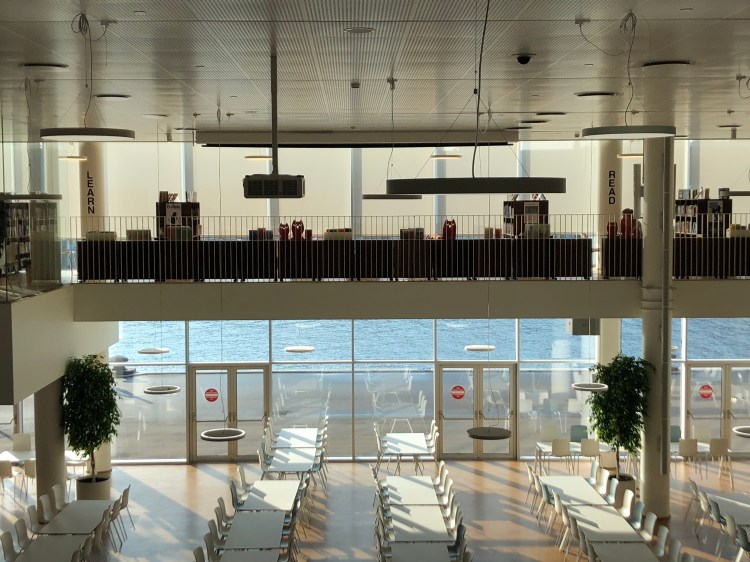
The street leading up to the school reminded me of a moat.  Once I entered the front doors, it seemed like a busy, happy place- just a very well-designed one.  Huge windows framed a common area and library, revealing a harbor lit up by golden sun rays.

IMG_1758.jpg

IMG_1779.jpg

Jessica co-teaches her kindergarten class with Andy, who wasn’t there- so there was a substitute to fill in for him.  Jessica was elegant and gregarious.  She gave me some fast facts about CIS: It’s inclusive, so students with special needs are included in the general education classroom.  Some go to the school counselor as needed.  The curriculum is concept-based.  It’s called PYP, short for Primary Years Program: this is an International Baccalaureate model.  Many of the learning activities tie into a theme that is explored across the curriculum within different subjects- at the time, the concept was: “people around the world celebrate different things for different reasons.”

Jessica asked me if I’d like to run a center. Centers are different learning activities available to the students.  The children can work through the activities with or without adult supervision, depending on the intentions of the teacher and the adult to center ratio.  Jessica explained that she and Andy have a responsive classroom, a concept that I was familiar with from UCSB: this style of management incorporates routines where the kids take turns speaking on personal and/or academic topics, converse with one another, and often do a bonding activity.  The aim is to develop social skills and emotional connections within the classroom.

IMG_1759.jpg

The different centers included:

  • -Bread baking with Jessica: Students tested two roll recipes: one with yeast and one without yeast.  Rolls were baked and the results analyzed.
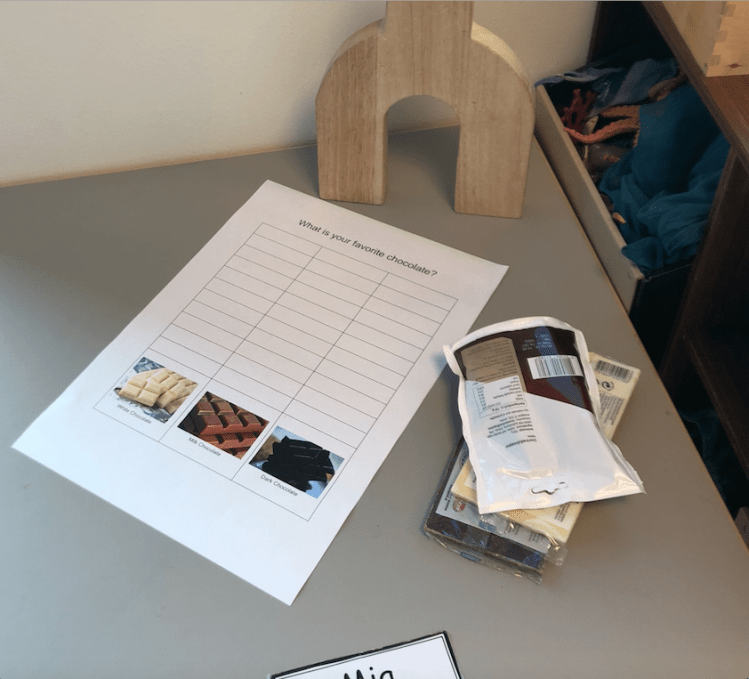
  • -Chocolate tasting and bar graphing: I facilitated this activity by calling kids one-by-one to taste dark, milk, and white chocolates and record their favorites on a bar graph
  • Self-guided play using blocks
  • Labeling pictures with cut-out vocabulary words (managed by the substitute)
  • Visual cues for “Bon fire night” aka Guy Fawkes Day, coupled with a chart divided into “How” and “Why”.  A parent from the UK had come into class to explain the holiday to the kids.

The children had laminated name tags that they carried with them to their center of choice.

As you can imagine, my job as chocolate-handler made me pretty popular with the kids.

Screen Shot 2018-12-11 at 2.36.54 PM.png

For more information on how the architecture informs the education, as well as brilliant photographs of CIS:

https://www.cfmoller.com/p/Copenhagen-International-School-Nordhavn-i2956.html