Helsinki grew colder and darker as the winter days deepened.
I woke up in the early morning and layered on all of the clothing I could. Once on the city street the morning rhythms seemed out of sync with the feeling of perpetual night.
International School of Helsinki spans transitionary-kindergarten through 12th grade. It is an independent International-Baccalaureate World School. There is a lower school (TK-5) and an upper school (6-12).

Once inside the main lobby ISH has a feeling of order and monumentality. A dense collection of colorful international flags frames the corridor. A “living wall” of tropical ferns and mossy vegetation is set cleanly into a spare white entryway. Each stair in the impressive central staircase features a color-coded multiplicative equation.


Once inside the spacious auditorium I found the fifth grade class in dialogue with the principal of ISH in a sectioned-off area upstairs. The principal was leading a presentation and discussion on sustainability. She asked students, “What do we need to do as individuals to be committed to sustainability?” before eliciting their recommendations to make the school more sustainable. “What are some questions we need to ask ourselves as a school?” Students volunteered thoughts catalogued by the principal: “Should we use solar power?” “Do we need a green roof?” “LED lights take practically no energy…” To which a student responded, “Have you heard of the super cool new bio lights? They mimic countries with more sunlight..”
After around fifteen minutes it was time for my appointment to observe a transitional kindergarten class. I tiptoed out and found a large classroom behind the living wall. There were eight three year olds in the class. They would turn four that year. There were three adults present.


The group had gone to Cable Factory that morning- a cultural center housing a theater museum. By the time I arrived the class spent the majority of the time in play before afternoon snack and a closing circle.
The environment was a relaxing one. Emotions flared as tired children interacted. When these occasions occurred the teachers focused their full attention on facilitating resolutions. One of the teachers told me, “The only thing they need is trust.” She assured me that even children so young could develop self-awareness and therefore self-regulation.
A little boy started to cry and one of the other teachers, Cath, intervened. She instructed him to take a deep breath. “Ivan, Can you explain?” She said, “I’m happy you’re upset because it means that you know you’ve done something wrong.” Cath attempted to elicit Ivan’s’ apology (I wasn’t clear on what had happened) , but Ivan could not seem to say it. Cath was persistent. “You need to say sorry before you can play again, Ivan.” Ivan: “Sorry, Sebastian.” After saying the words Ivan crumpled to the floor and cried.
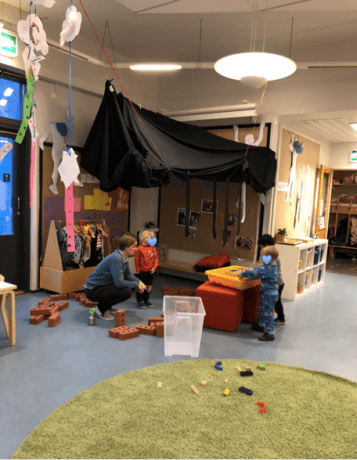
Snack included banana, watermelon slices, and buttered crackers.
Teacher facilitated learning continued.
“Take three grapes.”
“How many grapes do you have?” “This one’s for “fffff…. Who could that be?”
After the class helped to tidy up everyone sat in a circle. The question each person would answer was: what was your favorite part of the museum?
After everyone had spoken, a student was chosen to be “the teacher” to choose a number for the class to count up to. To close the school day the class sang a goodbye song.
After dismissal teachers helped students layer, zip, tuck, and secure themselves into warm clothes and boots.


Information on The Cable Factory: https://www.kaapelitehdas.fi/en/info
 The living learning experience