Europaskolan is located on a narrow street in the medieval part of Stockholm called Gamla Stan. This is the preserved part of the city that attracts tourists from around the world. Churches loom impressively and forebodingly above eccentric, claustrophobic city streets. Hoards of people traverse topographic cobbled stone.
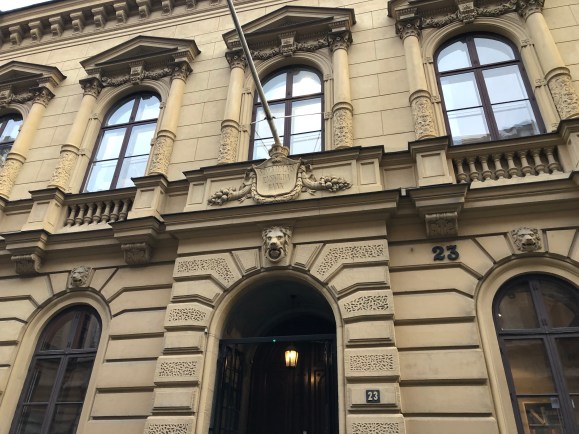
One would never know that such a beautiful school exists within this microcosm, just beyond a large, nondescript wooden door. Within the tiered lobby the ceilings are vaulted, the walls are gold-paneled, and classical murals decorate the high walls.


Europaskolan describes itself as an International Baccalaureate World School that also meets all requirements of the Swedish national curriculum. The school is bilingual; there are classes taught in Swedish and in English. I observed a class of ten and eleven year olds. These kids switched between two teachers. I observed a math class, lunched with the staff, and finally observed a science lesson before the school day ended.
Before the lesson began, students circulated and wrote three compliments about their classmates at those classmates’ desks. This appeared to be customary in the class. Students happily socialized in Swedish.
I was so fortunate to get to know their teacher, Robert, who was both passionate about teaching kids to learn through discovery and generous with his passion and knowledge. Robert utilized many of the same inquiry-based mathematics teaching strategies that I’d been taught while earning my teaching credential at UCSB. For instance, I immediately saw posters throughout the classroom from what I came to know as a “Math Congress”. In this type of learning scenario students work together in groups to solve a problem, record their strategy on a poster, and present that strategy to the class.


The math lesson that I observed in Robert’s math class was from the YouCubed curriculum. I learned about YouCubed from Morgan Senzamici, who was my teacher mentor at Isla Vista Elementary. It was so interesting for worlds to collide this way- I got to see the same lesson implemented in both Californian and Swedish classrooms.
YouCubed is a free K-12 math resource from Stanford University’s Graduate School of Education. I would describe the curriculum as constructivist: the lessons are experiential and it is through experience that students are meant to construct meaning and logical systems.
In this particular lesson, students worked with partners, sugar cubes, and markers. The initial question that Robert posed was: imagine that we paint a 4 x 4 x 4 cube blue on every side. How many of the small cubes have 3 blue faces? The question extended to: how many cubes have 2 faces painted? 1 face painted? And so on.
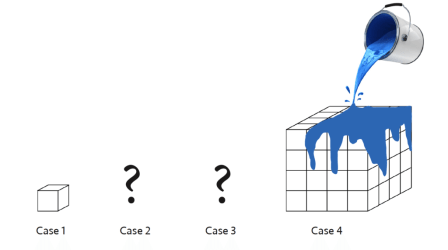
During the course of the initial conversation, Robert asked open-ended questions. As students explored ideas, he reminded them: “We’re talking about cubes and all of the sudden we’re talking about fractions again and decimals again.” Once the class had examined the question from different angles, Robert said to his class, “Why don’t you first make a prediction? Build the cube and see if you were right. That would be interesting.. ” When a student brought up a perceived complication, Robert’s enthusiastic response was: “Test it! So, test it!”
While the students worked Robert shared with me that making connections between mathematics was something that he consciously made sure to do. He wanted math to be fun and he wanted to validate student thinking. At one point a student pointed out that not every amount of sugar cubes can combine to form a cube. Robert responded, “That’s really interesting. Write that down in your book.”

Robert told me that he was inspired by the British educator Jo Boaler, a mastermind of YouCubed and author of the book “Mindset Mathematics: Visualizing and Investigating Big Ideas.”
He also highly recommended the game “Prime Climb” for the classroom. Students reiterated- “This is a really good game!”

Prime Climb is made by a company called Math for Love, which, in addition to math games, also offers free math lessons as well as more extensive (not free) curriculum.
Check out Math For Love: https://mathforlove.com/
Check out YouCubed: https://www.youcubed.org/
 The living learning experience