I observed Jennifer’s first & second grade classroom at Berlin Bilingual School. The school is on the outskirts of Mitte close by a large city park.
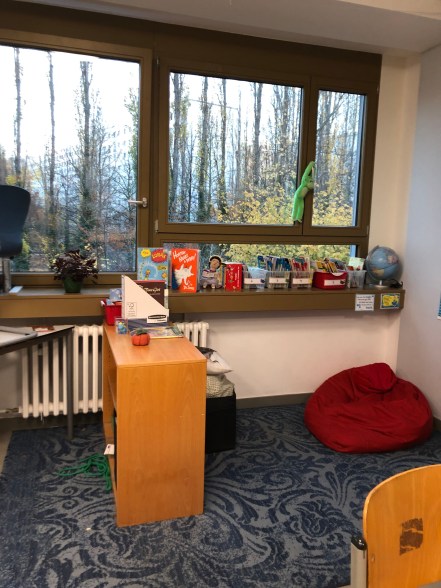
The classroom was spare and functional, the facilities polished and well-maintained. Blue autumn light streamed through large windows overlooking lemon yellow leaves and dark brittle branches. The days were getting darker, earlier.

At Berlin Bilingual School all subjects are taught in English except German and mathematics. The curriculum is a combination of Berlin State curriculum (Berliner Rahmenlehrplan) and International Primary Curriculum. Class groups are composed of children spanning two consecutive grade levels (grades 1 +2 and grades 3 + 4).
I initially inferred that the additional adult in the classroom was a classroom aide. I was incorrect- at Berlin Bilingual School each classroom has a teacher and an Erzieher, or educator. The role of the Erzieher is to support students socially and emotionally. The Erzieher remains with children throughout the school day, including at lunch and on the playground at recess.
In addition to academic curriculum there is a rich schedule of electives. Glancing at the schedule I noticed myriad options: pottery, high speed drawing, yoga, weaving, woodwork, ink on paper, mandala design, dance acrobatics, soccer, karate, decoupage, kickball, library, “bracelets’ n’ braids, “phunky alphabetz”, outdoor games…
After a break Jennifer told the children to come to the carpet. It was “STEM” (Science, Technology, Engineering, and Mathematics) week. Jennifer introduced a task to the children- to design a robot. She gave the kids time to think before inviting them to share ideas with a partner. As students talked she walked through groups, listening to their ideas. After a thirty second warning, students earnestly shared their ideas with the class. Later, Jennifer told me that there would be workshops available for them to actually build the robots.
After differentiated classwork Jennifer called students back to the carpet to read a book called “A Grand Old Tree” aloud.
“Boys and girls. I have a story I’d like to share today. When we’re listening today we’re going to be listening for words with color, variety, and sparkle. I want to see if you can notice some words or phrases, some words that together sound great to your ears… If you hear a word you really like, you can go like this (expressive hand movement.)
Jennifer went on to animatedly point out specific words as she read the story. “You can say the leaves fell. But it’s so much nicer to say the leaves shed.”
After she read “A Grand Old Tree”, Jennifer listed the standout words. “These are some of the words that I liked, that have color, variety, and sparkle.” She acted out the phrase “crackle and snap” and asked students to guess which phrase from the list she was referring to.
Next, she grouped students into groups of three: one second grader paired with two first graders.
Jennifer: The first thing you need to do is read. The second grader can help read. Then you’re going to pick a word or phrase from the list to act out for the class and your classmates will guess which word from the list you chose.”
“We’re going to use communication.” Jennifer and the Erzieher modeled communication. They took turns speaking and listening.
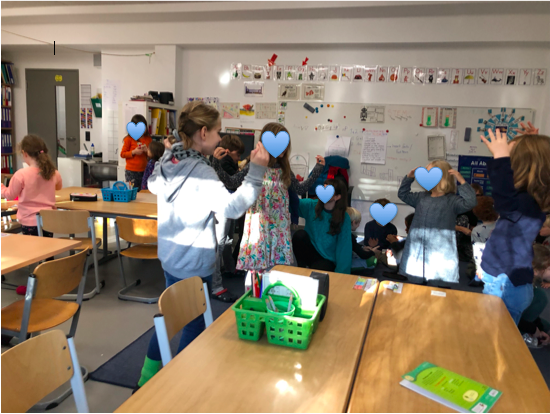
I watched as students read to one another before getting up and moving their bodies, smilingly miming trees in various states of contortion.
After the activity, Jennifer asked students, “Does someone want to share how you communicated well?”
After discussing the merits of listening to your partner, it was time to eat snacks before students filed out of the classroom at the end of the day. Jennifer invited me to go make some tea in the Kinderkuche (Kid’s kitchen) at the end of the hall.
After discussing education with the warm and kind Jennifer, I stepped back out into the chilly city.


 The living learning experience